
Santiago, Chile – Since his election victory on December 14, Chile’s president-elect, José Antonio Kast, has focused much of his agenda on a series of trips in South America, seeking to advance and coordinate future agreements and alliances across the region.
In visits to Argentina, Ecuador, and Peru, Kast has opened dialogues on key campaign priorities including combating transnational organized crime, addressing illegal immigration, and strengthening economic cooperation.
Less than 48 hours after winning the election, José Antonio Kast made his first trip as president elect to neighboring Argentina, where he met with President Javier Milei and members of his administration.
Aligned on the hard right and sharing a similar political vision, the two leaders held a meeting that notably lasted more than an hour.
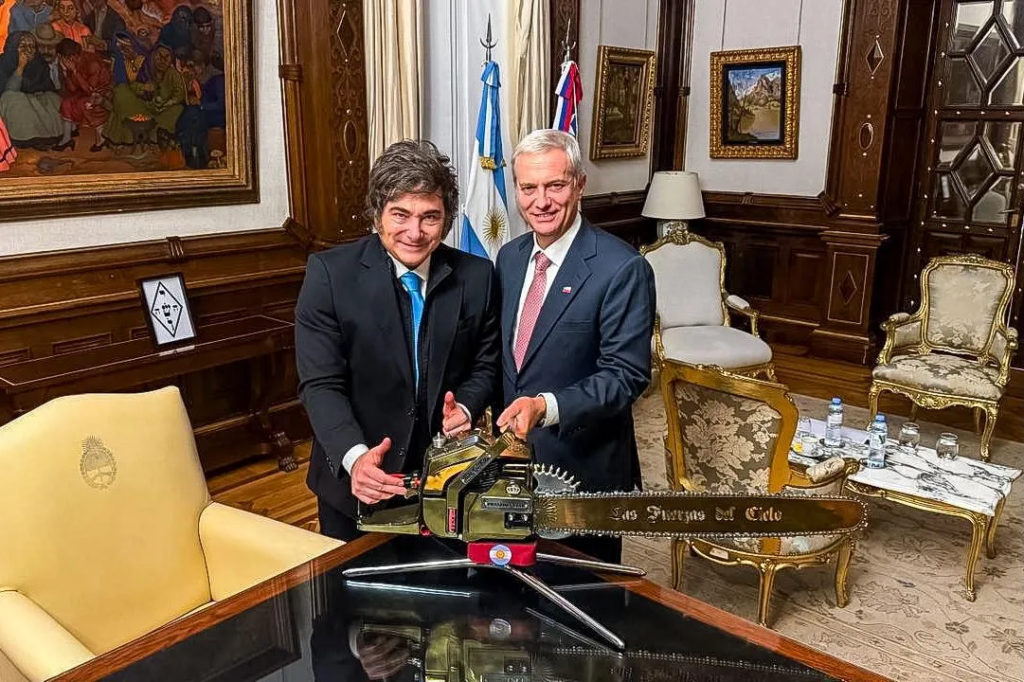
Meeting between José Antonio Kast and Javier Milei at the Casa Rosada / Official photo posted by José Antonio Kast on his Instagram account
The talks covered a range of issues, including national and border security, the fight against organized crime, investment, cooperation, trade promotion, and key sectors of the economy. Both leaders said they had outlined a roadmap for the period following José Antonio Kast’s inauguration on March 11, and Milei confirmed he would attend the ceremony.
In an official statement, the Argentine government outlined the mission agreed upon by both leaders: “the defense of freedom, life, and private property, in a spirit of cooperation and mutual trust, and with the political will to pursue sustained growth in both countries and greater security in the region.”
The statement formalizes the start of a much closer alliance, marking a clear break from the more strained bilateral relationship during the presidency of Chile’s current leader, Gabriel Boric.
Just days after José Antonio Kast’s visit to the Casa Rosada, he headed on his second international trip, this time to Ecuador.
On December 22, the president-elect arrived in Quito with the aim of forging strategic bilateral agreements and alliances with the government of Ecuadorian President Daniel Noboa.
The day after their arrival, the two leaders held their flagship meeting at the Carondelet Palace.

Meeting between José Antonio Kast and Daniel Noboa at the Government Palace in Quito / Official photo posted by José Antonio Kast on his Instagram account
Transnational security was the central focus of the talks; both leaders agreed on the need to coordinate agreements and develop a joint action plan to counter the growing threat posed by transnational criminal groups, with the aim of strengthening security, stability, and development across the region.
Another objective of the Chilean president-elect’s visit was to examine Ecuador’s high-security incarceration model, which was inspired by El Salvador’s CECOT prison developed under President Nayib Bukele. Kast has said he aims to draw lessons from Ecuador’s experience as he considers potential reforms to Chile’s prison system.
One of the most significant proposals raised by Chile’s incoming government was the creation of a “Regional Humanitarian Corridor.” The initiative would establish a secure route allowing irregular Venezuelan migrants to leave Chile and transit through Peru and Ecuador without settling, either to return to Venezuela or continue to other destinations. While Kast did not detail a concrete response from Ecuador’s president, he said both leaders shared a common understanding of the issue.
In the first half of 2025, President Noboa repealed the amnesty that had allowed Venezuelan migrants without formal status to regularize their situation in Ecuador, as part of an effort to address the country’s migration crisis.
The move underscores the policy alignment and shared approach of both leaders on migration issues and could pave the way for further progress on this initiative following the change of government in Chile.
“What we have proposed during this tour is to explore how a humanitarian corridor could be established so that people who are in Chile, Peru, and Ecuador illegally can return to their homeland”, said Kast
The idea of establishing a humanitarian corridor has drawn significant criticism. Several international treaties to which Chile is a signatory include the principle of non-refoulement, which prohibits states from expelling or returning individuals to a country where their lives may be at risk. The United Nations has repeatedly highlighted the existence of a humanitarian and political crisis in Venezuela, which could be seen as at odds with these international obligations.
In addition to migration, Kast and Noboa discussed a range of economic issues, including fiscal spending, inflation control, economic growth, and public policy design. Kast expressed strong interest in understanding the political challenges President Noboa faced in implementing key measures, viewing Ecuador’s experience as a useful reference for advancing his own policy agenda.
For their third and most recent stop to date, Kast and his team traveled to Peru, where they met with President José Jerí. The meeting took place on January 7 at the Government Palace.
As neighboring countries not separated by the Andes, Chile and Peru face a number of closely shared challenges. Among the most pressing is the rapid expansion of illegal mining, which has increasingly taken hold in extraction sectors and has become a bilateral concern for both governments.
Mining plays a central role in the economies of both Peru and Chile. In Chile, the copper industry accounts for roughly 14 to 16% of national GDP, while in neighboring Peru it represents about 10 to 12%
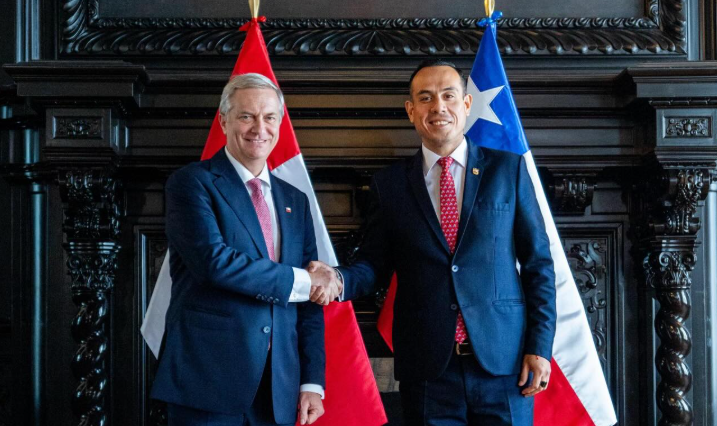
Meeting between José Antonio Kast and José Jerí at the Government Palace in Lima / Official photo posted by José Antonio Kast on his Instagram account
Illegal extractive activities are also controlled by transnational criminal networks. Addressing this, Kast spoke at length about the need for decisive action and concrete measures to combat organized crime in the sector. Among the proposals discussed with Jerí and his team was sharing border control technologies to prevent exports of illegally sourced materials.
“Organized crime has no flags, no borders, and does not respect the laws of countries. If we do not unite in this fight, how can we combat it?” said José Antonio Kast at a press conference.
The talks also addressed ways to strengthen bilateral cooperation beyond mining, including tourism, transportation, and connectivity between the border cities of Arica and Tacna. “When Arica does well, Tacna does well,” Kast said, underscoring the importance of closer ties between border communities and of encouraging cross-border investment.
But the two nations failed to reach a consensus on the pivotal issue of migration. In line with discussions at previous stops, Kast floated the idea of establishing a humanitarian corridor to facilitate the orderly transit of undocumented Venezuelan migrants.
But in recent remarks to CNN en Español, the Peruvian president dismssed the proposal, saying, “the option of a humanitarian corridor has been ruled out. We now need to work through our foreign ministries to determine what collective mechanism can be implemented to facilitate the return of irregular migrants to their home country.”
Asked by the press about Peru’s rejection of the proposal, José Antonio Kast responded,“everything will be fine.”
If José Antonio Kast’s election marked a significant shift in Chile’s domestic politics, his frenetic diplomatic activity ahead of taking office underscores a broader ambition, to reshape the geopolitical axis of Latin America.
In less than a month, the president-elect has sought to forge a regional alliance grounded not only in ideological alignment with leaders such as Javier Milei and Daniel Noboa, but also in a shared urgency to combat transnational organized crime and revive stagnant economic sectors.
Kast aims to move beyond symbolic diplomacy toward what he has described as a “diplomacy of security,” centered on border cooperation and private investment as new pillars of regional integration.
Featured image: Jose Antonio Kast delivering a speech.
Featured image credit: @joseantoniokast via X.
The post Chile president-elect Kast targets crime and migration in diplomatic drive appeared first on Latin America Reports.