On May 24, Colombia’s President Gustavo Petro posted on X denouncing an “international alliance of the ultra-right” which was seeking to interfere in presidential elections being held this Sunday.
The so-called “Hondurasgate” responds to a series of audios leaked in late April indicating an alleged conspiracy between the United States, Israel and Argentina to destabilize left-wing governments in Latin America, including in Colombia.
Leaked recordings, first published by Diario Red, allegedly tie former Honduran President Juan Orlando Hernandez to conservative actors in these countries who set out to spread disinformation about leftist governments in Mexico, Colombia and Brazil.
Such international coordination is not new; since at least last August there have been reports of the far right in Colombia developing increasingly sophisticated ties with extremist groups in Latin America, Spain and the United States.
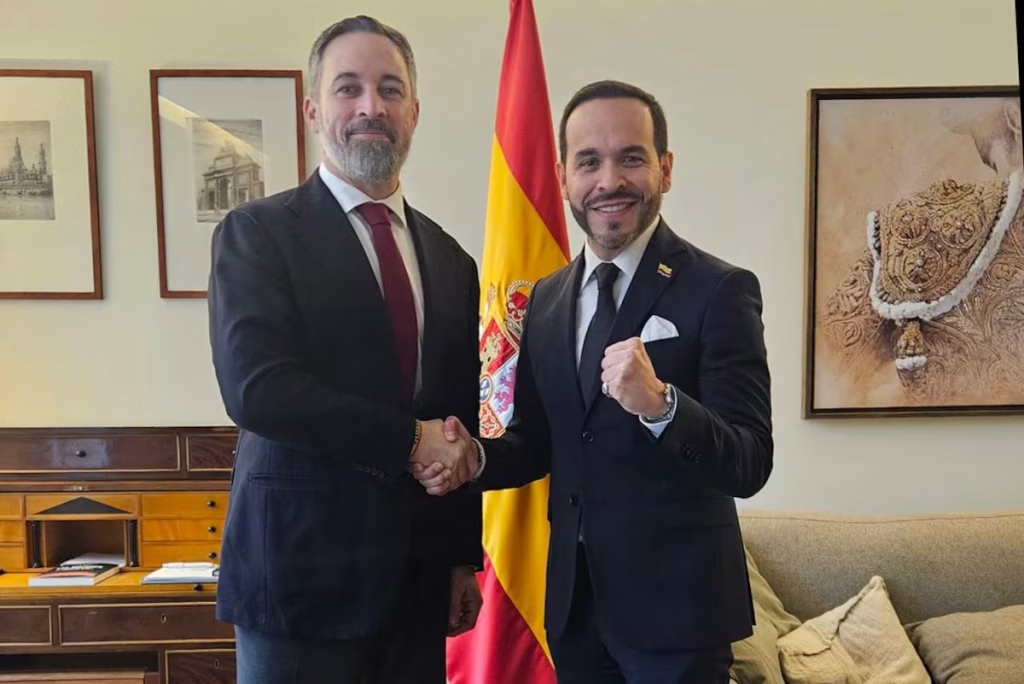
These cross-border networks include significant figures in Colombian politics. In January, presidential hopeful Abelardo de la Espriella travelled to Madrid where he met Santiago Abascal, leader of far-right Spanish Vox party, and participated in the Foro de Madrid, an alliance of right-wing leaders and groups across Europe and the Americas.
A recent investigation by Bellingcat and Cerosetenta also connected Jorge Rodríguez, ex- congressional candidate for the Centro Democrático, to an alleged member of the global neonazi group Active Club in Bogotá. Rodríguez has been a keen supporter of another contender for the presidency, the Centro Demcrático’s Paloma Valencia.
As Petro’s post suggests, there are also more powerful influences at play. On May 20, Republican Senator Bernie Moreno told a meeting of the Atlantic Council that the United States might not recognize the result of Sunday’s elections if there is evidence of voter intimidation.
Moreno, who is of Colombian origin and has been invited to oversee the elections as an international observer, also denounced the Petro administration and claimed it would be an “abject disaster” if the country voted in another leftist government.
Colombia’s history with the global far right
As a historian of 20th-century Colombia, focussing particularly on political and social developments in the mid-1900s, I am aware that Colombia’s growing entanglement in the global far right also has historical precedents.
In the late 1930s and early 1940s, various right-wing groups across the country cultivated cross-border connections with fascist-inspired groups in Europe and Latin America.
In the context of Liberal social reformism, Conservative weakness and a growing fear of communism, several movements emerged across the country (but principally in Bogotá and Medellín) which sought inspiration from Nazism, Italian fascism and, most importantly, Spanish Catholic nationalism.
The onset of the Spanish Civil War (1936 to 1939) allowed these groups to forge tangible links with their European counterparts in the form of fundraising campaigns for Nationalist troops in Spain, propaganda visits from representatives of General Francisco Franco and the establishment of local branches of the Falange Española, a fascist political party.
These connections strengthened the Colombian far right financially and politically, making them a not insignificant force in the country.
Colombia in the mid-20th century was clearly a very different political and social scene. For starters, it had a bipartisan political system and the Catholic Church played a very influential role in politics.
However, it is worth taking note of the consequences of this previous international mobilization, particularly as the far right plays a much more significant role today.
Firstly, the growing audacity of right-wing movements led to the halting of a reformist agenda which, although imperfect, did aim to improve the lives of many Colombians.
It also increased political polarization in the country and infused popular and official Conservative discourse with a particular religious-based nationalism that would have disastrous consequences in the late 1940s when Colombia saw the outbreak of a more-than-decade-long informal civil war.
Finally, the sense that the country’s interests were better served as part of a wider conservative ideal, contributed to a constitutional reform bill in 1953 which sought to turn Colombia into a confessional corporatist state along the lines of Franco’s Spain.
This bill failed but provoked a coup that inaugurated the country’s only 20th-century dictatorship which was succeeded by a 16-year power sharing agreement that set the scene for the emergence of guerrilla movements from the 1960s.
Of course, no one can predict the long-term impacts of the upcoming election result. However, the events of the 1930s and 1940s should give pause for thought about what the involvement of certain presidential candidates in the global far right could mean for Colombia’s future.
The opinions and analysis expressed in this column are solely those of the author and do not necessarily reflect the views of Latin America Reports.
The post The ‘global far right’ in Colombia – lessons from history (Perspective) appeared first on Latin America Reports.