Bogotá, Colombia – A challenge to a public debate, accusations about football shirts used as political symbols, and increasingly sharp exchanges on social media — campaigning for Colombia’s run-off in its presidential election is already underway just a day after Abelardo de la Espriella emerged as the surprise first-round winner.
While Senator Iván Cepeda had been widely expected to come out on top and enter the second round in a stronger position, his camp was left disappointed after falling short of those expectations.
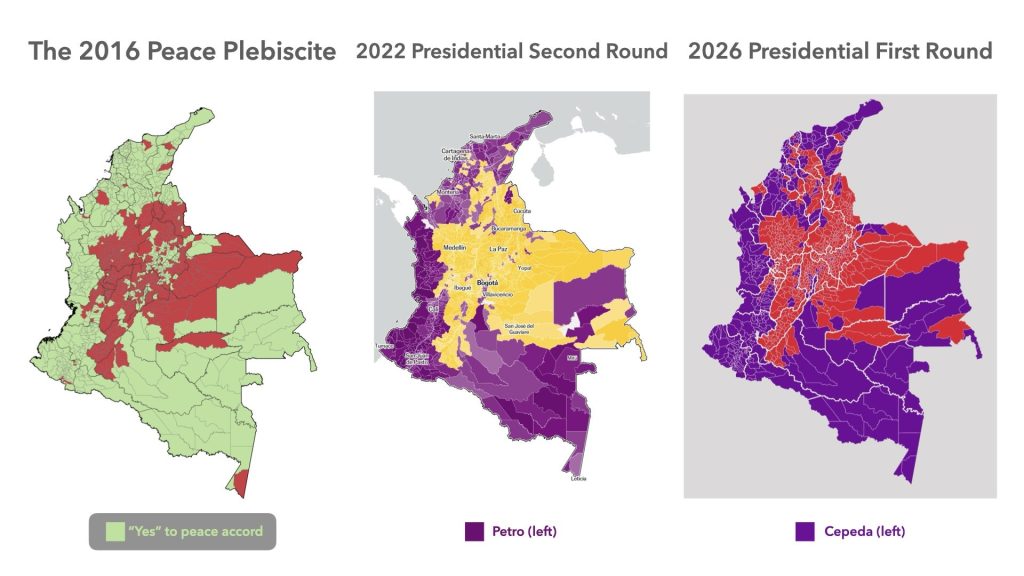
Although he still claimed nearly 41% of the tally, de la Espriella surpassed him by almost three points, coming out with 44%.
Analysts say the run off is wide open. An important factor is supporters of other candidates whose votes are up for grabs. But a decisive factor is also likely to be those who didn’t participate at all in the first round.
“Whoever manages to somehow win over the undecided voters who didn’t vote in the first round but will vote in the second, I think that’s already enough to be president,” political analyst Oscar Chala said.
With three weeks to go until the June 21 elections, the race is on to sweep up those votes, and the candidates haven’t wasted any time in trying to position themselves.
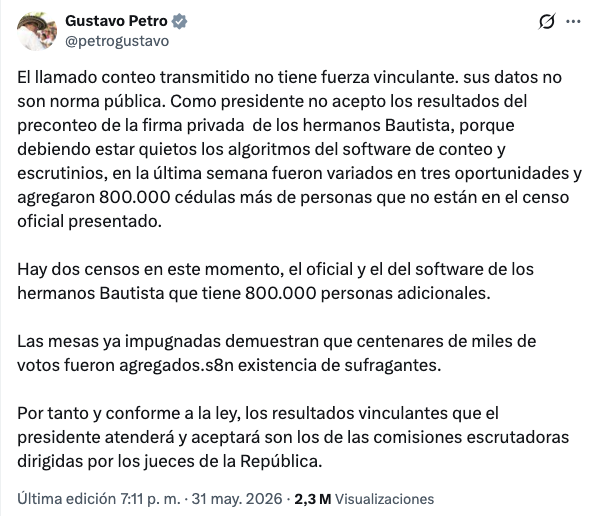
Shortly after the results, Cepeda’s camp alleged irregularities in the vote, although the candidate backtracked the next day, saying they were not significant.
He also criticised the wearing of Colombian football shirts as part of political campaigns, linking it to de la Espriella’s far right movement — and also challenged him to a public debate, something he had not previously participated in.
“Cepeda is now inviting and wanting to hold a debate when he had always avoided it. That is a sign of desperation,” Rubén Erazo, political consultant, told Latin America Reports.
Although de la Espriella accepted the debate — which will be held on Tuesday June 9 — he also called his rival a “coward” and accused his campaign of hiding behind Petro.
Despite the disappointing result for Cepeda, he gained roughly what polls had been predicting — even marginally higher. Yet analysts say he struggled to win over undecided and abstentionist voters and lacked a solid and coherent campaign.
“The failures of Cepeda’s campaign are that Cepeda is not himself the candidate. The candidate is the current president Petro,” political consultant Rubén Erazo said, referring to this election being more like a referendum on Petro’s legacy.
He said this incorporates “the good, the bad, and the ugly” of his presidency. While he expanded social programmes, other policies, such as opening ambitious negotiations with armed groups, were highly controversial. Those dissatisfied with what Petro stands for are likely to be against Cepeda.
Despite knockbacks, Erazo says this doesn’t mean it is game over for the senator and Petro ally.
“Cepeda could win as long as his team reorients his strategy, acknowledges mistakes, thinks calmly and does not focus solely on claiming fraud,” he said.
The race is still very much open — and analysts say anything could happen, and that a lot will depend on where they target their political energy.
“Cepeda is likely to move closer to the centre and Abelardo could become more radical. The strategy Abelardo will use to try to win is to radicalize his discourse because he knows that Iván Cepeda will start seeking centrist votes,” Chala said.
He believes Espriella will also target an abstentionist segment on the right, even further right than traditional right-wing establishment figures such as Paloma Valencia, who once polled above 20% but ultimately secured just under 7%.
This part of the electorate is conservative, often macho, and wants hardline security strategies and more investment in the country.
De la Espriella was the main candidate able to capitalize on this as well as anti-Petro sentiment, and is expected to continue drawing support from parts of Valencia’s former base.
“However, his discourse is very anti-establishment and he’s not seeking the support of political parties,” Chala explained.
Nevertheless, Paloma Valencia — and her mentor, former president Álvaro Uribe — have come out in support of de la Espriella. Her relevance is not yet completely diminished if she can convince those who supported her to shift to this camp.
Moreover, while Cepeda took a backseat in his own campaign and drew heavily on traditional strategies such as mass gatherings and marches, Espriella, as well as doing this, drew heavily on crafting his own image — calling himself “The Tiger”.
“Everything is exaggerated and trying to inspire: the planes, the Italian suits from when he was a lawyer, and even his image of advising controversial figures,” he said. “Even the beard, for example, is copied from Nayib Bukele. It’s the same style.”
De la Espriella is plainly anti-establishment and aligns himself with Nayib Bukele, Javier Milei and Donald Trump. That appeals to some of the electorate, and repels another part.
At this stage, both candidates are still very much in this race, with everything to play for.
Featured image description: Iván Cepeda (Left) and Abelardo de la Espriella (Right).
Featured image credit: Respective campaigns.
The post Tensions rise as Colombia presidential run-off campaign gets underway appeared first on Latin America Reports.