
By Diana Garay, Research Fellow at American University’s Center for Latin American and Latino Studies
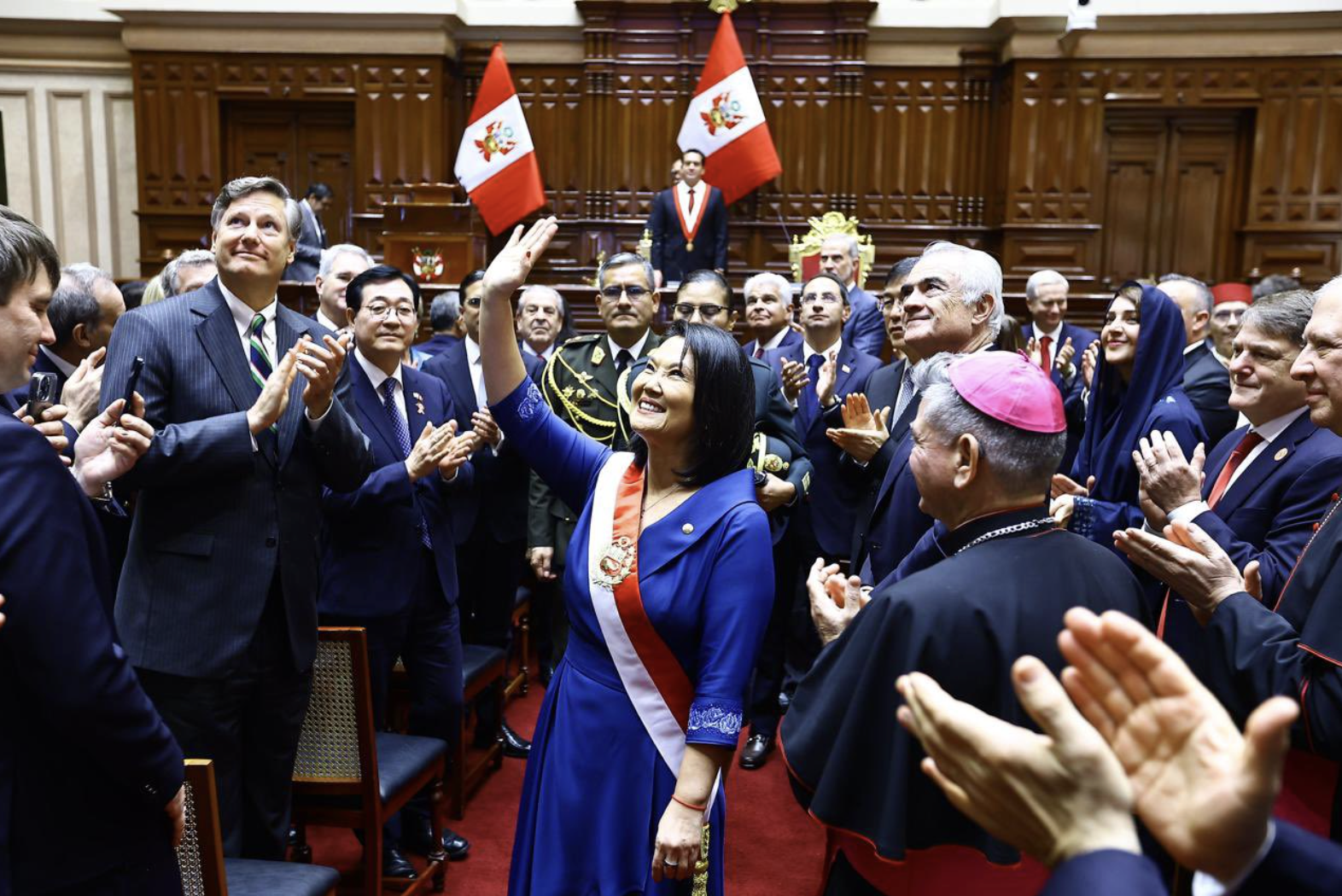
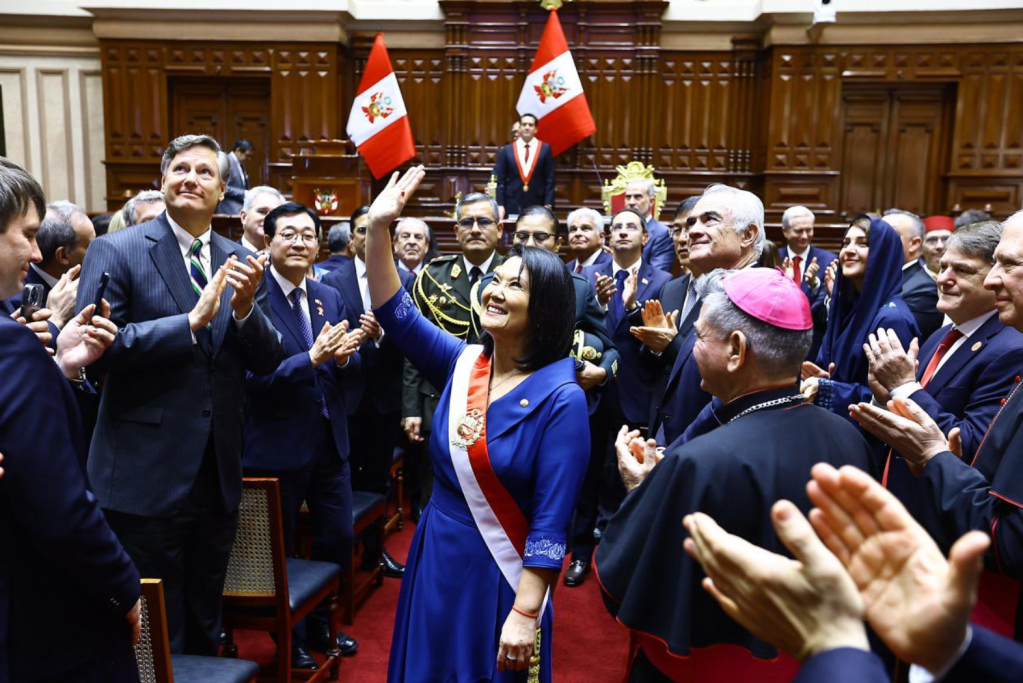
On July 28, 2026, Keiko Fujimori was sworn in as the country’s ninth president in a decade. Inside Congress, the ceremony displayed the full apparatus of a functioning democracy: a presidential sash, with a king and half a dozen visiting heads of state in attendance. Outside, a different reality was on display. In front of the Palacio de Justicia, demonstrators performed a symbolic lavado de banderas (“washing of the flags”), scrubbing the national colors clean, rejecting the incoming government and demanding justice for victims of state violence. Inside, a nation performing normalcy. Outside, a nation still counting its dead. This contradiction captures Peru’s central political dilemma. The institutions responsible for governing the country are also institutions that many citizens associate with years of instability, corruption, and unaddressed grievances. The question facing Peru is therefore not simply whether democracy can continue to hold elections, but whether it can produce legitimate and effective governance.
A Crisis of Governability
Peru’s crisis is not a failure of democratic procedure but of what those procedures have been used to do. Since 2016, the country has cycled through presidents at a pace virtually unmatched among democracies. Fuerza Popular, the right-wing populist party of the new president, became the most visible actor in this period of institutional instability, particularly after securing congressional dominance after the 2016 elections. Under its leadership, Congress transformed oversight mechanisms into instruments of political pressure against the government of Pedro Pablo Kuczynski, whose resignation in 2018 came amid repeated attempts to remove him through the vacancy process, a mechanism that allows Congress to declare the presidency vacant under specific constitutional grounds, including “permanent moral incapacity.” The confrontation continued under Martín Vizcarra, whose presidency ended in 2020 when Congress declared the presidency vacant on grounds of “permanent moral incapacity.”
Yet the political crisis that followed revealed that Peru’s instability extended beyond any single party or president. Manuel Merino’s brief government collapsed after widespread protests against Vizcarra’s removal, during which two young demonstrators, Inti Sotelo and Bryan Pintado, were killed by police forces, further intensifying public outrage and demands for accountability. Francisco Sagasti’s transitional administration provided only a temporary pause in a deeper institutional conflict. Pedro Castillo’s presidency exposed the opposite side of the same dysfunction: a president elected without a stable governing coalition who ultimately attempted to dissolve Congress and rule by decree before being removed in December 2022. Dina Boluarte’s subsequent administration deepened the legitimacy crisis, particularly after the deaths of protesters during the 2022-2023 demonstrations. Together, these episodes demonstrate that Peru’s problem is not simply presidential turnover; it is a political system in which neither presidents nor Congress have consistently possessed the legitimacy, institutional capacity, and public trust required to govern.
Institutions Designed for Conflict
Peru’s institutional landscape, however, has now entered a new phase. Fujimori’s inauguration marked the return of a bicameral Congress, but the reform itself was not the result of a new public mandate. In the 2018 referendum, more than 90 percent of voters rejected the proposal to restore a bicameral legislature, while also approving restrictions on congressional reelection. Despite those outcomes, in 2024 Congress reserved both through constitutional reforms, approving the restoration of the Senate and Chamber of Deputies and congressional reelection. This has fueled skepticism toward bicameralism, not necessarily because of opposition to a two-chamber legislature, but because it reinforces the perception that political actors can reshape institutional rules despite previous expressions of popular will.
Under the new system, at least theoretically no political force possesses enough power to govern without negotiation. The president’s supporters do not automatically control the legislative agenda, while opposition parties lack the votes to independently impose their own program or fundamentally alter the balance of power. This distribution of power means that governing will require agreements across political lines.
The difficulty, however, is that Peru’s recent crisis has not emerged because political actors lacked opportunities to negotiate. It has emerged because political competition has increasingly rewarded confrontation. Since 2016, Congress and the executive have repeatedly used constitutional mechanisms as instruments of political struggle, transforming checks and balances into tools for weaking opponents. The result has been a political system in which institutional rules exist, but the incentives surrounding those rules have encouraged obstruction rather than cooperation.
Bicameralism may make abrupt institutional breakdowns more difficult, but it does not guarantee governability. Without a change in political behavior, the country risks replacing one form of instability with another: not the rapid removal of presidents, but prolonged paralysis in which competing factions possess enough power to block each other but insufficient willingness to govern together.
Peru’s challenge, therefore, is not simply a question of institutional design. It is whether a political class has repeatedly contributed to the erosion of public trust can operate within institutions that depend on trust to function. The new Congress may prevent some of the excesses of the previous decade, but it cannot resolve the deeper question at the heart of Peru’s crisis: How can any type of sustained governance take place, either from the right or the left, given the bad faith of political actors that appears to undermine democratic institutional mechanisms of checks and balances?
A Society Mistreated
Peru’s governability crisis cannot be separated from the society it seeks to govern. The country is often described as politically polarized, but polarization alone does not explain the depth of Peru’s instability. The deeper fracture is historical: millions of Peruvians do not share the same experience of the state. For some, the state represents economic opportunity, security, and national progress. For others, particularly communities that have experienced decades of exclusion, violence, and limited public investment, the state has often appeared distant, ineffective, and harmful.
This distinction was recently captured by Cardinal Carlos Castillo during the Mass and Te Deum commemorating Peru’s independence, when he emphasized that Peru is not only a divided country, but also one marked by citizens who have been mistreated and forgotten by its institutions. His message reflected a broader reality: Peru’s crisis is not simply that citizens disagree about political solutions; it is that many citizens question whether the political system has recognized their suffering at all. In such a context, governability becomes inseparable from legitimacy. A government can win an election and possess constitutional authority yet still struggle to govern if large segments of society believe that the state has repeatedly failed them.
The country’s electoral geography reflects these unresolved tensions. Fujimori’s strongest support came from Lima and much of the coastal regions, while the losing leftist candidate Roberto Sánchez received stronger backing from the Andean highlands and areas where poverty, inequality, and distrust toward central institutions remain especially pronounced. These differences are not merely electoral preferences. They reflect contrasting relationships with the state itself: between a coastal economy that has benefited more visible from Peru’s market-oriented growth model and region that continue to experience the consequences of unequal development.
However, Peru’s divisions are not only geographic. They are also historical. Keiko Fujimori’s return to the presidency reopened unresolved questions about the legacy of Fujimorismo and its role in the country’s current crisis of trust. Alberto Fujimori’s government remains one of Peru’s most contested periods: remembered by supporters for defeating the Shining Path insurgency, but remembered by critics for authoritarianism, corruption, the weakening of democratic institutions, and serious human rights violations.
For Keiko Fujimori, the challenge is therefore larger than inheriting a controversial family name. She inherits the unresolved wounds associated with that political project while also representing a movement that has played a central role in furthering Peru’s protracted institutional conflicts after 2016.
What Lies Ahead
Peru’s future will not be determined by whether Keiko Fujimori completes her presidential term. That would represent progress compared to the instability of the past decade, but it would not, by itself, resolve the country’s governability crisis. The more difficult question is whether Peru’s institutions can once again become arenas for democratic representation rather than instruments of political conflict.
For Keiko Fujimori, the challenge extends beyond managing Congress or implementing policy. She must govern a society where many citizens associate the political movement she leads with the institutional deterioration she now promises to reverse. That credibility gap cannot be closed through rhetoric alone. It will depend on concrete choices: strengthening judicial independence rather than weakening it, addressing the demands for accountability that continue to resonate after the 2022-2023 protests, and demonstrating that public institutions serve citizens rather than political interests.
The question is no longer whether Peru can hold elections or transfer power peacefully. It is whether those elected can rebuild the legitimacy that makes democratic government possible. Until that question is answered, Peru’s greatest challenge is not simply to preserve democracy, but to make it believable again.