Bogotá, Colombia – Noticias Caracol, one of the largest media outlets in Colombia, released a statement on March 20 regarding an investigation into two of its lead journalists, Ricardo Orrego and Jorge Alfredo Vargas, following allegations of sexual abuse against some of their female colleagues.
The allegations sent shockwaves through the media industry, in part because of the reputation both men had built over their careers.
For decades, Orrego was the voice of Colombian sports, leading coverage of multiple World Cups and other international sporting competitions, while Vargas had been the charismatic anchor of Caracol’s prime-time news show for over 20 years.
Days after announcing the investigation, the network sent a follow-up message: both men had been removed from their positions despite them denying the allegations. Soon after, Orrego published a statement from his lawyer on X, saying the firing was “one sided” and that he would comply with any investigation. Vargas also published a statement saying he was stepping away from Caracol while saying he maintained “respect” and “good behavior” while working as a journalist.
The firings marked a pivotal moment for Colombian newsrooms and inspired dozens of female journalists to come forward and share their own experiences of sexual harassment, sparking a massive wave of solidarity under the hashtags #YoTeCreoColega (I believe you, colleague) and #MeTooColombia, while also exposing a deeply-rooted culture of harassment and abuse.
Fear: a reason for sharing an open secret
Before social media changed the news landscape, the men and women appearing on Colombian television screens to report the news became trusted icons for aspiring journalists, including myself.
As their star-power rose, questioning them became more difficult.
Longtime Colombian journalist Yolanda Ruiz wrote in her column for Spanish newspaper El País that the industry “has prioritized the ratings of its stars over the dignity of female journalists,” creating a “throne of impunity that is finally beginning to crumble.”
“It cannot be a surprise when the ‘open secret’ finally explodes,” she wrote.
The harassment isn’t just contained to the television industry either. According to a 2020 study by the Observatorio de la Democracia at Universidad de los Andes, which surveyed 158 female reporters, six out of 10 participants reported being victims of gender-based violence in their workplaces, while a staggering 77.9% stated they were aware of this kind of abuse against their female colleagues.
Several journalists (in this case, regardless of gender) have also claimed to be victims of workplace bullying, stemming not only from bosses and power figures but also from their own colleagues.
Beyond the situations of workplace and sexual harassment, journalists in Colombia also face low salaries and severe labor instability. According to a study by Universidad del Rosario, which surveyed 277 journalists, nearly half of the participants (137) stated they would leave the profession for another field if given the chance.
This reveals a toxic environment where intimidation was normalized at every level of the newsroom, creating a cross-sectional pattern of abuse that silenced those trying to build a career or keep their current positions within the industry.
Same pattern, different workplaces
Following the Caracol journalists’ harassment allegations, Colombian journalists Paula Bolívar, Juanita Gómez, Mónica Rodríguez, Laura Palomino, and Catalina Botero began the #MeTooColombia movement.
They were inspired by the #MeToo hashtag that arose in the U.S. in 2017 following revelations of sexual abuse by Hollywood producer Harvey Weinstein.
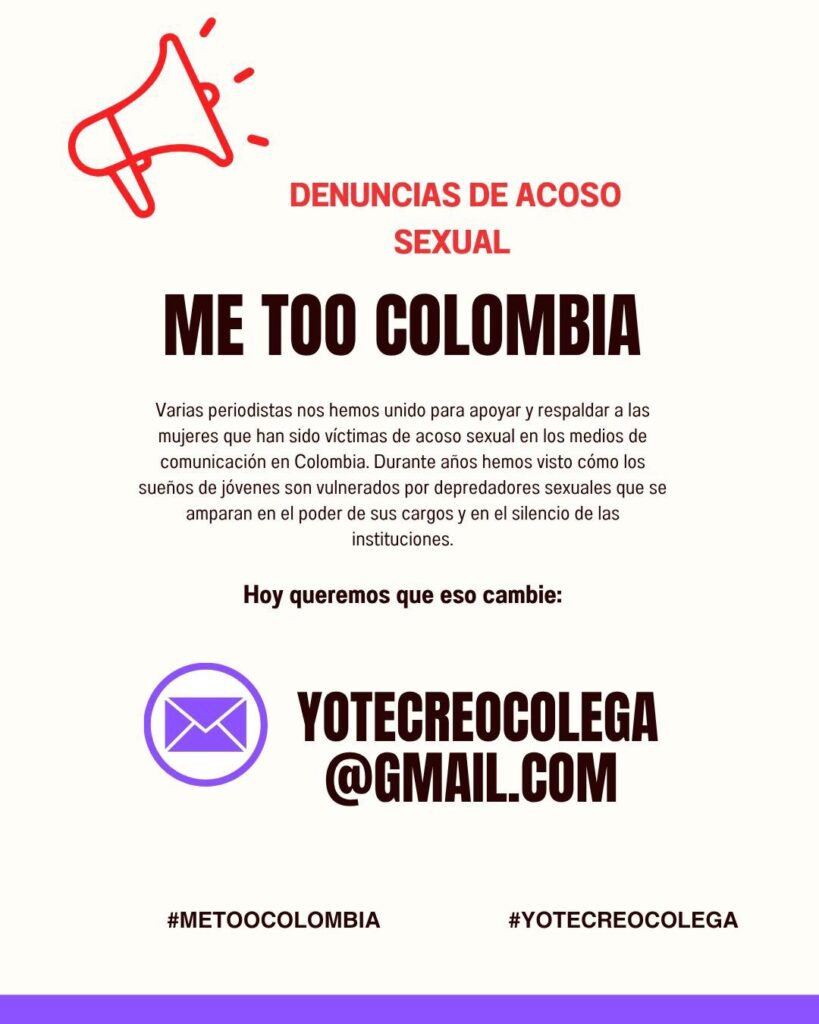
The group of reporters also established a dedicated communication channel (yotecreocolega@gmail.com) for victims to share their stories of abuse within newsrooms. The response was overwhelming: in just a week, they received at least 200 emails with testimonies ranging from 1993 to 2025.
In the case of Juanita Gómez and Catalina Botero, both prominent journalists who previously worked at Noticias Caracol and who currently serve at weekly news magazine Semana and state-owned radio station RTVC respectively, the initiative started by sharing on social media their own experiences.
Through her account on X, Gómez detailed aggressions she suffered from a well-known anchor while on an international assignment in 2015.
“I would tell her that having to force a journalist/presenter off you, several times and with pushing, so he wouldn’t kiss you in an elevator… is not normal and should never have happened,” Gómez wrote.
“I would also tell her to talk to her female colleagues, hopefully many of them, because they have much worse stories, and surely together they would find a way to report the harasser.”
This encouraged other women who worked at TV channel RCN, newspaper El Espectador, and other Colombian media, to share their own experiences.
Some questions began to surface: if this is a systemic pattern across the entire media industry, why has only one outlet spoken out publicly? And more importantly, why is this reckoning happening only now?
The fact that Juan Roberto Vargas, the director of Noticias Caracol, has publicly addressed the situation inside the media outlet as “painful” and “sad” marks a significant first step, one that directors of other major media outlets should follow.
His commitment to taking “decisive measures” sets a precedent in an industry where silence has long been the standard response to internal abuse.
The end of an era: Breaking the cycle of impunity
Eight years ago, Lina Castillo publicly accused Hollman Morris—the current director of the public radio broadcaster RTVC—of sexual and workplace harassment.
The journalist’s public allegations were turned against her, however, after Morris filed a defamation complaint, arguing her accusations were damaging his reputation.
Driven by the #YoTeCreoColega movement, a group of more than 40 women, including journalists, lawyers, and writers, joined together to sign an open letter questioning the case against Castillo and denouncing Morris’s legal actions. They argue that his goal is not to seek justice, but “to silence the women who report him.”
In March, following pressure from social organizations, the case was transferred to a higher court to ensure “gender sensitive analysis.”
Additionally, Jineth Bedoya, an award-winning journalist who became a symbol of the fight against gender-based violence following her kidnapping, torture, and rape at the hands of right-wing paramilitaries in 2000, recently took the issue of harassment in newsrooms to lawmakers.
On March 25, Bedoya testified before Congress, calling on lawmakers to end the “pacts of silence” that have protected predators in newsrooms for decades.
“A group of women journalists is here today to remind you that, for decades, women in the media have had to carry the burden of gender-based violence,” she stated. “No more pacts of silence in newsrooms. Today is not the time to remain silent.”
The #MeTooColombia movement is also seeking legal recourse for victims. The Attorney General’s Office reported over 50 complaints of sexual and workplace harassment within the media industry in less than a week after the initial allegations involving journalists from Noticias Caracol came to light.
Victims were encouraged to report abuse to a special email set up by the Prosecutor’s Office: denuncia.acoso@fiscalia.gov.co.
The tip of the iceberg?
On April 7, the Ministry of Labor published a document detailing immediate measures imposed against Noticias Caracol. This followed an inspection of Caracol TV and BLU Radio facilities, which could potentially be extended to other media companies.
“There are clear signs of a possible failure in the mechanisms for prevention, attention, and investigation of workplace sexual harassment within the company,” the statement pointed out.
The investigation also revealed that one of the accused, Ricardo Orrego, had received prior warnings in 2023 and 2025. However, there are no documents identifying the complainants behind them or any evidence of a structured disciplinary procedure.
Regarding the disgraced journalist, the Ministry ordered a “documentary reconstruction process” for the warnings issued to Orrego. The goal is to “identify the original complaints, the departments involved, and the reasons why no formal disciplinary procedures were ever carried out.”
At the same time, the inspection uncovered 15 new complaints of potential sexual harassment. These cases had remained invisible, either because victims didn’t report them or because the company simply failed to handle them through the proper channels.
While Caracol’s decision to go public marks a rare and necessary first step, the Ministry’s ongoing oversight serves as a reminder that this is an open investigation—and a warning for the rest of the industry.
Hear from the women
As this report focuses on a culture of silence within Colombian media, Latin America Reports reached out to several victims of harassment directly.
These journalists shared their stories on the condition of anonymity to protect their safety and professional careers.
Their testimonies offer a look at the cases that have remained hidden for years.
Giving a voice to these experiences is essential to breaking the cycle of harassment and silence, prioritizing the human experience over the data:

The abusive touching from that older man—who claimed to be the owner of a renowned media outlet—left me completely paralyzed.
He approached my friend and I when we were just young women, speaking in a sickening tone. ‘Do you want to be part of my team? Please, don’t hesitate to contact me,’ he told her, while his hand kept moving all over her body and his mouth was disturbingly close to hers.
“You should remain silent and avoid creating unnecessary drama… It’s for the best,” the HR leader told me when I tried to ask for help regarding my abusive boss. I tried so hard to remain calm, but the harassment became my shadow.
He would call me desperately at any hour, screaming and berating me for no reason. My phone became a source of terror. I stopped sleeping, and when I finally had a moment of peace, my anxiety wouldn’t let me rest. I found myself waking up every few minutes, trembling, just to check my screen, waiting for the next blow.
I decided to talk to him man-to-man as a last resort. He looked at me with a smirk and said: ‘You have to understand that humiliations are part of the daily grind here. Only those of us who live in the newsroom know how to truly value them.’ Then, he softened his voice: ‘Don’t worry, you have a brilliant future ahead. You are on the right track.’
But his ‘mentorship’ was a lie. Just minutes later, I overheard him mocking me to a colleague, calling me a ‘crying baby’ who was unable to perform even the simplest tasks (even though I was doing my work and his). I decided to give up. Nobody ever listened. Or worse, they were spectators of the mistreatment and chose to look the other way.
Being an intern arriving in a newsroom is a dream come true. You watch those leading the day, seeing them on a pedestal, unaware of the power dynamics hidden behind the cameras.
The eyes shining and the hunger to ‘reach the top of the world’ are just a few steps away, but you’re new in an industry that is not as you imagine. Humiliations, screams, and rude remarks, all of them, are the daily meal.
You can see everyone getting nervous, but you can also feel the envy among colleagues—reporters pushing others away, making fun of them, or giving them derogatory nicknames to ruin their reputation. They are always on the lookout for their failures… It’s like a high school horror movie about bullying.
All of a sudden, the first message arrives on your phone: “Your ass is amazing, can I have a bite?” It comes from a colleague, much older than you, who has been leading the top stories for years and has falsely offered to share his professional secrets with you.
You’re nobody. You have just arrived at your first job—what can you really do? Report it to the director? He doesn’t even know who you are yet; you haven’t even had the chance to show what you’re capable of. It’s better to say nothing, even if each time the messages get worse and you feel more and more repulsed.
It’s part of ‘building character,’ was always heard.
Featured image: Ricardo Orrego and Jorge Alfredo Vargas
Image credit: David Gonzalez for Latin America Reports
The post Colombia’s #MeToo moment highlights abuse within media organizations appeared first on Latin America Reports.