
Medellín, Colombia – On October 14, Colombia’s Foreign Minister Omar Bula and his Israeli counterpart, Gideon Sa’ar, attended a ceremony inaugurating Colombia’s new embassy in Jerusalem.
Colombia became only the tenth country to relocate its embassy from Tel Aviv to Jerusalem, a politically charged move in a city split between Israeli and Palestinian rule.
The move is the latest in a slew of measures by President Abelardo de la Espriella restoring ties with Israel and reversing sanctions imposed by the previous administration, positioning Colombia as one of Israel’s closest allies on the world stage.
“Today, with the opening of our embassy in Jerusalem, we are taking a decisive step toward strengthening the bonds of brotherhood and ties between our peoples,” Bula said during the inauguration ceremony.
He also took aim at the policies of ex-President Gustavo Petro, who severed diplomatic ties with Israel, saying relations “should never have been broken.”
El presidente @ABDELAESPRIELLA cumple su promesa de campaña: Colombia abre su Embajada en Jerusalén.
El canciller @omarbula encabezó la ceremonia de inauguración, un paso concreto para reconstruir la relación con Israel, fortalecer la confianza mutua y avanzar en una agenda… pic.twitter.com/Dc4bVHWPqr
— Cancillería Colombia (@CancilleriaCol) October 14, 2026

“The decision is controversial, largely because Jerusalem remains a disputed city. Internationally, it is not universally recognized as part of Israel. As a result, while some countries maintain consulates in the city, the vast majority of nations keep their embassies in Tel Aviv,” Arlene Tickner, the former Colombian ambassador to the United Nations, told Latin America Reports.
For Tickner, relocating its embassy to Jerusalem places Colombia among a small group of countries that have “symbolically recognized” the city as Israel’s capital, while overlooking the unresolved Palestinian claims to Jerusalem.
The embassy relocation drew criticism from elements inside Colombia who oppose Israel’s war against Gaza, which the United Nations has categorized as a genocide.
“It is a decision that does not encourage dialogue as a solution to the violence in the region, but rather undermines it. To put it plainly, it implicitly condones and endorses the (ab)use of force by Netanyahu’s government,” wrote Colombian political scientist and international relations scholar Sandra Borda on X.
The death toll from Israel’s military offensive in the Gaza Strip since October 7, 2023 – when Hamas killed 1,195 Israelis – is over 74,000.
The criticism extended internationally. According to Colombian newspaper El Espectador, the foreign ministers of 19 Arab and Islamic countries condemned the opening of the embassy, expressing their “categorical rejection” of the move and calling on Colombia to reconsider and reverse its decision in a joint statement.
A reset in relations
Tickner said the embassy relocation is likely designed to signal de la Espriella’s close ties with Israel and the U.S.
“It is an unqualified alignment with Israel, with the State of Israel, and, by extension, with Donald Trump’s administration in the United States, because the two go hand in hand,” said Tickner.
With Abelardo de la Espriella’s arrival in government, Colombia’s foreign policy has shifted dramatically, particularly in its stance toward Israel compared with the previous administration of Gustavo Petro.
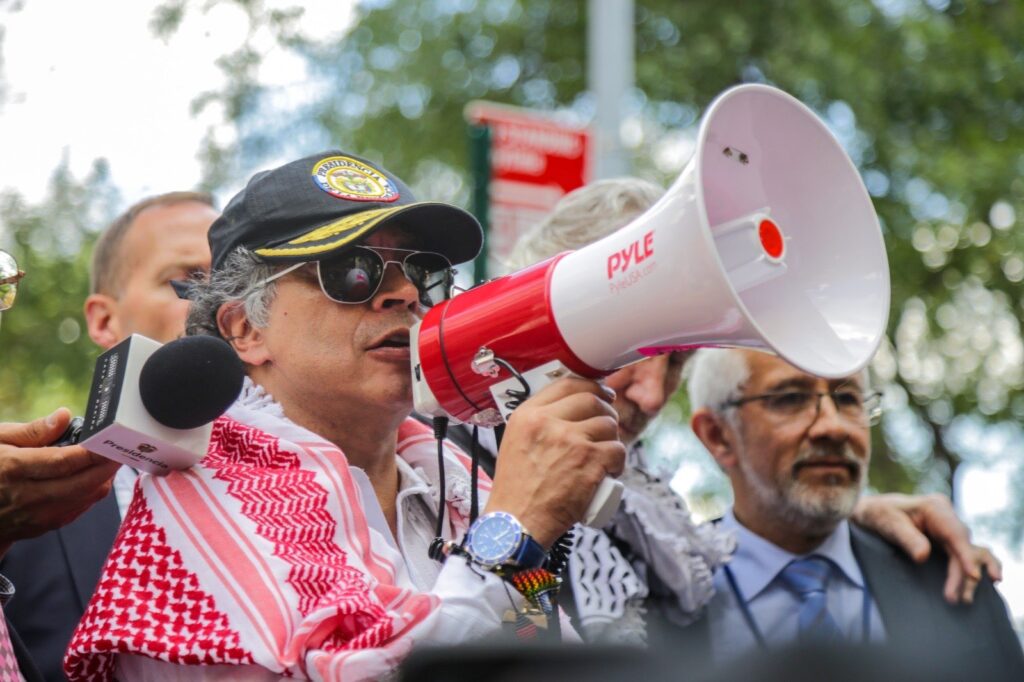
The former president characterized Israel’s actions in Gaza as genocide, criticized the Israeli government in international forums, and severed diplomatic relations with Israel.
In the first two months of his administration, the new president restored diplomatic relations with Israel, resumed coal exports and recognized Israeli sovereignty over the disputed Golan Heights.
Colombia also formally withdrew from the declaration supporting South Africa’s genocide case against Israel before the International Court of Justice (ICJ) and lifted visa requirements for Israeli citizens effective on September 1.
But Tickner emphasized that the bitter relations under the Petro administration were the exception, not the rule.
“Colombia and Israel have maintained close, if not special, ties long before this administration. Relations became even stronger and more intensive, particularly during (Alvaro) Uribe’s government,” said the former diplomat.
What sets this moment apart, according to Tickner, are two key decisions: relocating the embassy to Jerusalem and recognizing Israeli sovereignty over the Golan Heights, a position recognized by only the United States. She argued both moves disregard the existing international legal framework governing these issues.
“This marks a departure from previous administrations, including Uribe’s, and also represents a concerning shift away from Colombia’s longstanding tradition of upholding international law, the United Nations Charter, and resolutions adopted by the international body,” said Tickner.
Featured image description: Colombian Foreign Minister Omar Bula met with Israeli President Isaac Herzog on his visit to Jerusalem.
Featured image credit: @CancilleriaCol via X.
The post De la Espriella resets relations between Colombia and Israel appeared first on Latin America Reports.